Business simulation for universities and business schools

Every decision accountable.Every score explainable.

EdXsim® is the business simulation where every learner runs their own company and is scored on the decisions they make.

See how a Year runs

Enterprise pilots: hello@edxsim.com

Text of the video: Meet EdXsim. Every learner runs a company. And then every score has a reason. Own books. Own targets. Own score. The business simulation that grades the individual.

In numbers

Six numbers that describe EdXsim

Each one describes the product, not how many people use it.

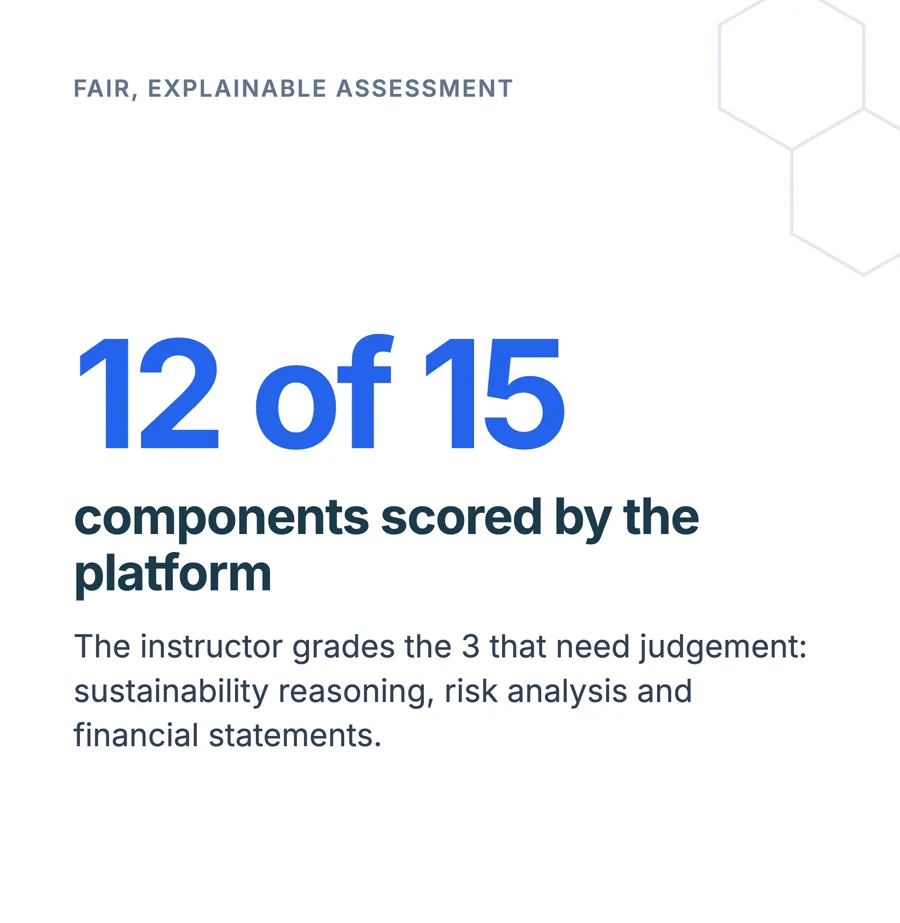
  • 12 of 15 components are scored by the platform. The instructor grades the 3 that need judgement: sustainability reasoning, risk analysis and financial statements.
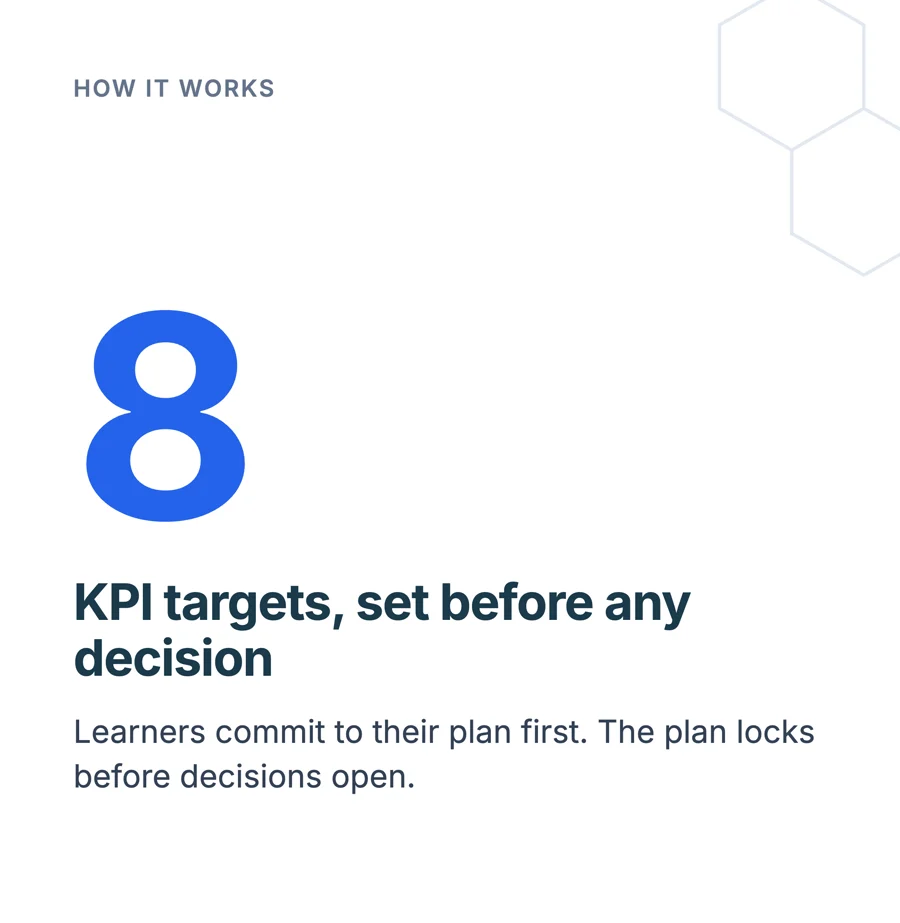
  • 8 KPI targets, set before any decision. Learners commit to their plan first. The plan locks before decisions open.
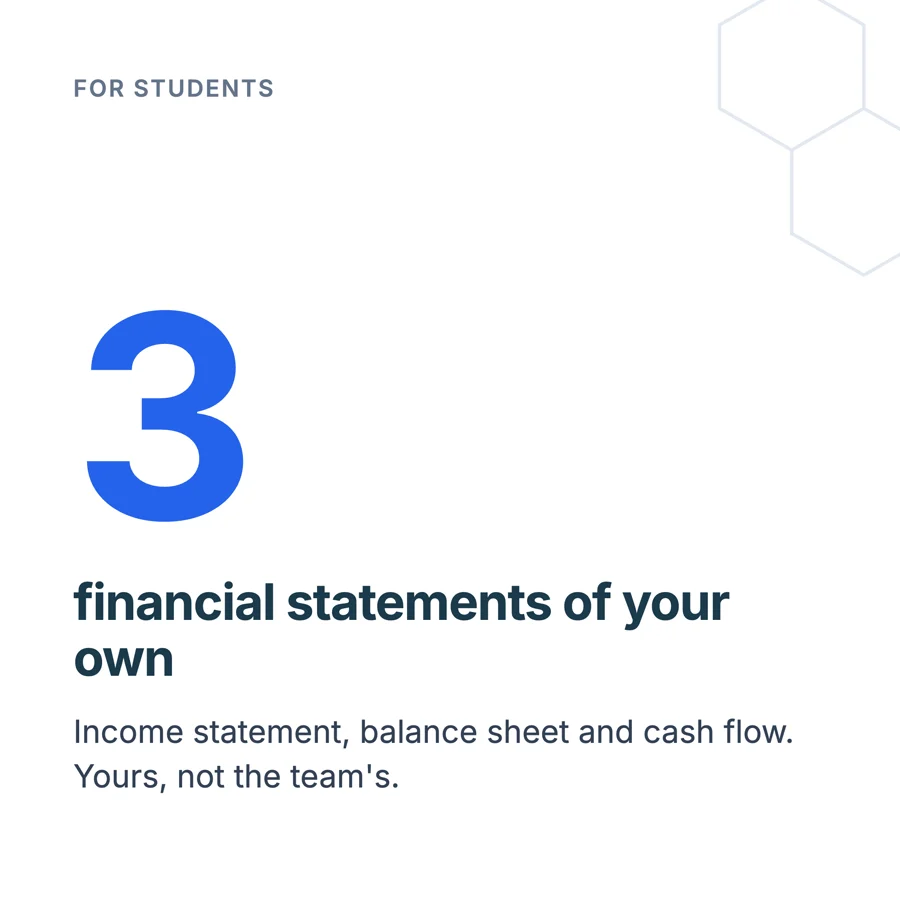
  • 3 financial statements of your own: income statement, balance sheet and cash flow. Yours, not the team’s.
  • 15 ESG indicators mapped to UN SDGs. Learners plan them, deliver them through their decisions, and are scored on both.
  • 8 seats at the board table: CEO, COO, CSO, CMO, CFO, CPO, CLO and CCO. Every member of a company holds a role.
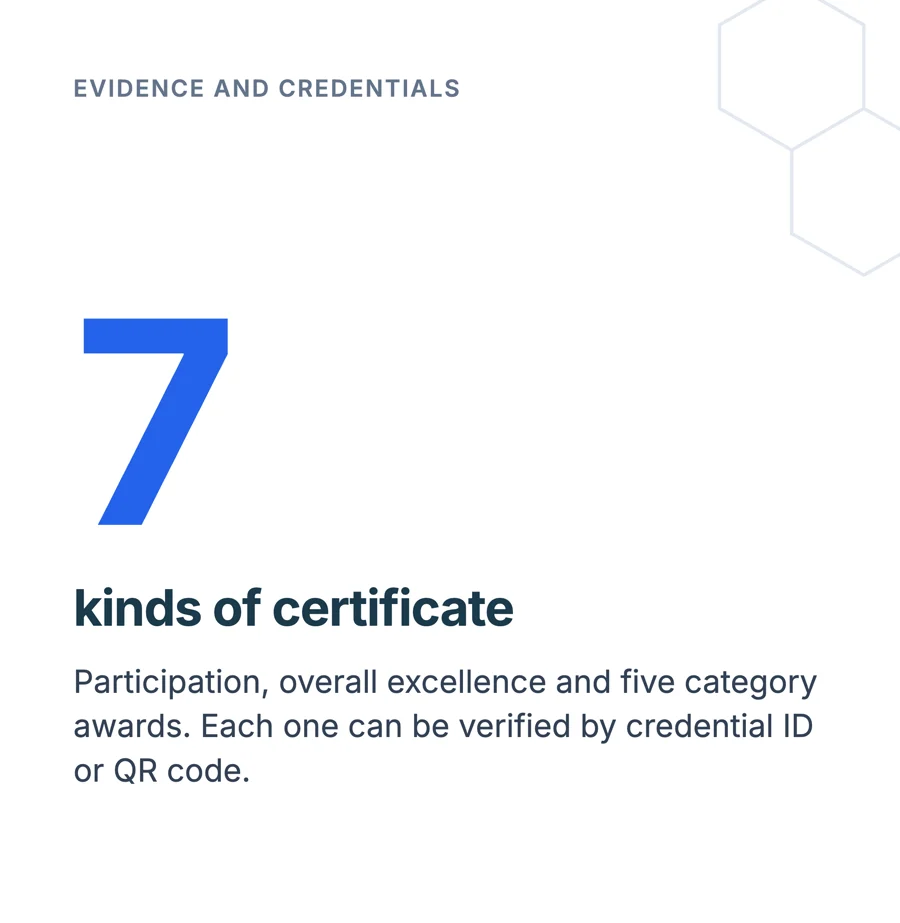
  • 7 kinds of certificate: participation, overall excellence and five category awards. Each one can be verified by credential ID or QR code.

The problem

Team grades hide who decided

Most business simulations grade the team, score against fixed benchmarks, and leave the rest to manual marking.

  • Team-only results

    A passive member earns the same grade as the one who drove the company.

    In EdXsim every learner keeps their own books, and a company's results are the sum of its members' results. When every member plays, a member who doesn't submit scores zero for the Year.

  • Fixed benchmarks

    Market position counts for more than forecasting and execution.

    Learners are scored on how close they land to the targets they set. An ambitious target that fits their chosen strategy can earn the most points.

  • Manual marking

    Grading grows with every extra cohort, and scores stay hard to explain.

    The platform scores 12 of the 15 components. Instructors grade the three that need judgement, and every component is named and weighted.

How it works

How a simulated Year runs

The plan is locked before decisions open, so every learner commits to targets before they know the outcome.

Read the text of this video
  1. How it worksA simulated year, step by step
  2. First, commit1. StrategyThe CEO confirms the company strategy.2. PlanEach member sets targets, SWOT and ESG.
  3. ThenThe plan locks.Learners commit to targets before they know the outcome.
  4. Then, perform1. DecideMembers run operations in their own books.2. ScoreThe platform scores results against the plan.3. GradeThe instructor adds three qualitative marks.
  5. Then the next year begins.And the cycle repeats, year after year.
  6. Plan. Decide. Score. Grade.Request a demoedxsim.com
  1. Strategy

    The CEO confirms the competitive strategy for the company.

  2. Plan

    Each member sets eight KPI targets, a SWOT and the sustainability initiatives they will deliver.

  3. Decide

    Members run markets, pricing, production, marketing and finance, each in their own books.

  4. Score

    The platform scores 12 of the 15 components against each learner’s own targets.

  5. Grade

    The instructor adds three qualitative assessments, and the score and rankings update.

In 15 seconds

One idea at a time

Short silent films, each making one point about how EdXsim works. Press play on any of them; the text is underneath.

  • Four students. One grade. Who decided?

    16 seconds · silent

    Read the text of this video
    1. Team gradesFour students.One grade.Who decided?
    2. What a team grade hidesThree questions it cannot answer1. Who planned?Who set the targets.2. Who decided?Who made each call.3. Who learned?Who can explain the result.
    3. EdXsim grades the individual, not the team.Request a demoedxsim.com
  • Good market. Good grade. Good judgement?

    15 seconds · silent

    Read the text of this video
    1. Fixed benchmarksGood market.Good grade.Good judgement?
    2. The EdXsim wayScored against your own plan.Each learner is measured on how close they land to the targets they set.
    3. Forecasting and execution are what count.Request a demoedxsim.com
  • One simulated year. Five steps.

    18 seconds · silent

    Read the text of this video
    1. How it worksOne simulated year.Five steps.
    2. How a year runs1. StrategyThe CEO confirms the strategy.2. PlanEach member sets targets.3. DecideMembers run their own books.4. ScoreResults are scored against the plan.5. GradeThe instructor adds three marks.
    3. The plan locks before decisions open.Request a demoedxsim.com
  • One company. Up to eight sets of books.

    15 seconds · silent

    Read the text of this video
    1. How it worksOne company.Up to eight sets of books.
    2. Individual accountingThe company is the sum of its members.Every member’s choices are booked in their own accounts.
    3. Individual accountability inside team play.Request a demoedxsim.com
  • Plan first. Decide second.

    15 seconds · silent

    Read the text of this video
    1. How it worksPlan first.Decide second.
    2. Before any decision8 KPI targets each learner setsThe plan locks before decisions open.
    3. Commit to a target, then see how close you land.Request a demoedxsim.com
  • Take a seat at the board table.

    15 seconds · silent

    Read the text of this video
    1. For studentsTake a seat at the board table.
    2. In every company8 board rolesCEO, COO, CSO, CMO, CFO, CPO, CLO and CCO.
    3. You are scored on your own decisions.Request a demoedxsim.com
  • Why did I get this score?

    17 seconds · silent

    Read the text of this video
    1. Explainable assessmentWhy did I get this score?
    2. Every KPI shows1. TargetWhat you planned.2. ActualWhat your decisions delivered.3. GapThe distance between them.4. DecisionThe choice behind it.
    3. Every decision accountable.Every score explainable.Request a demoedxsim.com
  • A certificate anyone can check.

    16 seconds · silent

    Read the text of this video
    1. Evidence and credentialsA certificate anyone can check.
    2. Seven kinds of certificate1. ParticipationFor completing the program.2. Overall excellence1st to 5th place.3. Five category awardsRevenue, profitability, market share, marketing and sustainability.
    3. Verified by credential ID or QR code.Request a demoedxsim.com

What makes it different

Every result is earned, and every result is their own

Individual accountability

Every learner runs their own books

Each learner gets their own income statement, balance sheet and cash-flow statement from a double-entry ledger. A company’s statements are the sum of its members’, so each person’s contribution is visible.

Accounting in EdXsim
An EdXsim income statement for a demo company in Year 2: revenue of $147.7 million, a gross margin of 29% and earnings before interest and tax of $34.4 million, with each operating expense on its own line.

Fair, explainable assessment

Scored against the strategy they chose

Eight KPIs are scored by how far each result lands from the learner’s own target. Instructors set the weighting through Scoring Profiles, locked at Year 1.

  • Eight KPIs measured against each learner’s own targets
  • A 0–100 score from 15 named components
  • Weightings set by your institution

How the score is built

The Final Performance Score: 15 weighted components, 12 scored by the platform and 3 graded by the instructor.

34 seconds · silent · text on screen

Read the text of this video
  1. AssessmentHow the score is builtThe Final Performance Score, from 0 to 100.
  2. The score has15 weighted componentsWeights come from the Scoring Profile the instructor chooses.
  3. Four groups1. 8 quantitative KPIsRevenue, market share, margin and more.2. 1 sustainability scoreWhat decisions actually delivered.3. 3 alignment checksFit with the chosen strategy.4. 3 qualitative marksGraded by the instructor.
  4. Of those 1512 are scored by the platformThe instructor grades the 3 that need judgement.
  5. The principleScored against your own targets.An accurate forecast of an ambitious plan scores highest.
  6. Assessment you can defend.Request a demoedxsim.com

A market that pushes back

Sales are won, not declared

Demand in each market is shared between the companies competing there, by price, quality and marketing. Three products, four country markets and a 52-week inventory schedule: running out of stock costs real sales.

The competitive market
Demand in a market is shared between the companies competing there, according to how attractive each offer is on price, quality and marketing. The bars are illustrative of the mechanism and show no specific figures.

Market demand, one Year

  • Your company
  • Rival A
  • Rival B
  • Rival C

Share is won on three things, against whatever rivals do:

  • Price
  • Quality
  • Marketing

Sales are also capped by the stock actually on hand that week.

Who it is for

Built for everyone in the room

Assessment you can defend

Scores that come from each learner's own decisions, with every component named and weighted. Run many programs from one account, with role-based access and data kept separate for each institution.

  • Every component of the score is named and weighted
  • Many programs run from one account
  • Data kept separate for each institution
Value for institutions

What a program leaves behind

What a program leaves behind: a report for each Year and for the program, and seven kinds of certificate.

33 seconds · silent · text on screen

Read the text of this video
  1. Evidence and credentialsWhat a program leaves behindReports and certificates for every learner.
  2. Reports1. One for each yearWhat happened and why.2. One for the whole programWith driver analysis and a proposed SWOT.
  3. Certificates come in7 kindsParticipation, overall excellence and five category awards.
  4. The five category awardsRevenue. Profit. Market share. Marketing. Sustainability.
  5. And every certificateScan it. Verify it.Anyone can check one by its credential ID or QR code.
  6. Evidence for learners and institutions.Request a demoedxsim.com

Sustainability

Sustainability that is scored, not only taught

Learners choose from 15 ESG initiatives across environmental, social and governance themes, each mapped to the UN Sustainable Development Goals. The suppliers they choose determine how much of that commitment they deliver, and instructors assess the reasoning separately. With a ready-made profile, sustainability carries 20% of the score, or 60% in an ESG-focused course.

Sustainability in EdXsim
Fifteen ESG initiatives in three themes of five: environmental, social and governance. The ready-made Scoring Profiles weight sustainability at 20 percent or 60 percent of the score.

ESG initiatives

Environmental5
Social5
Governance5

Mapped to the UN Sustainable Development Goals, and scored in both the plan and the decisions.

Strategy Focused
20%
ESG Focused
60%

Share of the score in each ready-made profile. A custom profile can weight it higher or lower.

Reports and certificates

Evidence at the end of every program

Reports and certificates give learners something to keep and institutions something to show.

An illustration of an EdXsim certificate: a title, a recipient line, an award line, a seal, and a credential ID with a QR code for public verification.
  • Seven kinds of certificate

    Participation, overall excellence and five category awards.

  • A report for each Year, and one for the program

    With driver analysis and a proposed SWOT. The instructor reviews each report before it is published.

  • Public verification

    Anyone can check a certificate by its credential ID or QR code.

Coming soon

In development

Work in progress, and not part of EdXsim today.

  • Coming soon

    EdXsim Coach

    AI coaching for learners between Years

  • Coming soon

    LMS integration

    Launch from your LMS and send grades back

  • Coming soon

    Single sign-on

    Sign in with your institution's identity provider

Coming soon features are in development and are not available today. We don't publish release dates, and plans can change.

See EdXsim with your course in mind

Tell us what you teach and how large your cohorts are. We'll walk you through a program set up for it.

No credit card needed