The platform
A business simulation built to be assessed
EdXsim® covers strategy, markets, R&D, production, marketing, finance and sustainability in a single loop. Every number a learner sees comes from their own double-entry books, and every point of their score can be traced to a named component.
The Year
A simulated Year, in five steps
A program runs for 1 to 10 Years, set by the instructor. In each Year, every learner commits to a plan before making decisions. When the Year closes, the market is resolved across the whole cohort, then books are posted, results calculated and companies ranked. Learners see results only for Years that have closed, so the Year in play is never given away.
- 1
Strategy
The CEO confirms the competitive strategy for the company.
- 2
Plan
Each member sets eight KPI targets, a SWOT and sustainability initiatives.
- 3
Decide
Members run operations, each in their own books.
- 4
Score
The platform scores results against each plan.
- 5
Grade
The instructor adds three qualitative assessments.
When a Year closes: the market is resolved, books are posted, then scores and rankings are calculated.
Planning
Commit before you compete
Each Year starts with a strategy plan. The CEO confirms the company's competitive strategy. Then each learner writes their own plan and submits it before any decision can be edited, so targets are set before results are known.
What a plan contains
- Competitive strategy (one of four, shared across the company)
- Vision and SWOT analysis
- Eight numeric KPI targets, which become the yardstick for scoring
- Sustainability initiatives, chosen from 15
- Product definition and growth path
- Capital deployment
Decisions
Real trade-offs, market by market
Once plans are in, the CEO confirms which markets the company will enter and where it will be headquartered. Decisions then open for every member.
- Markets
- Which of four countries (United States, United Kingdom, Bangladesh, Nigeria) to enter. More become available as Years progress
- Headquarters
- Where the company is domiciled. Corporate tax follows headquarters, not where the sales are made
- Pricing and positioning
- Price per market, target group and management focus
- Production and sourcing
- Units to produce, which manufacturer and distributor to use (eight of each, unlocked step by step), stock per market
- Marketing
- Channel spend, with a minimum offline campaign so every company competes for attention
- R&D
- Investment that raises product quality, with a ceiling that moves between five and seven stars with performance. Sustained investment can unlock an exclusive manufacturer and distributor pair
- Assets
- Capital assets for the business
- Finance
- Loans from Year 2, with fixed terms by loan type, taken directly or through instructor approval
Decisions are checked for affordability before they can be submitted.
The market
Sales are won, not declared
Demand in each market is shared between the companies competing there, according to how attractive each offer is on price, quality and marketing. A great price only wins against the prices around it. Quality earns share only where buyers value it. Marketing converts only against rival marketing.
Every program sells a real product
The instructor chooses Bicycle, Smartphone or Drone, each with its own demand and price bands by country.
Supply is week by week
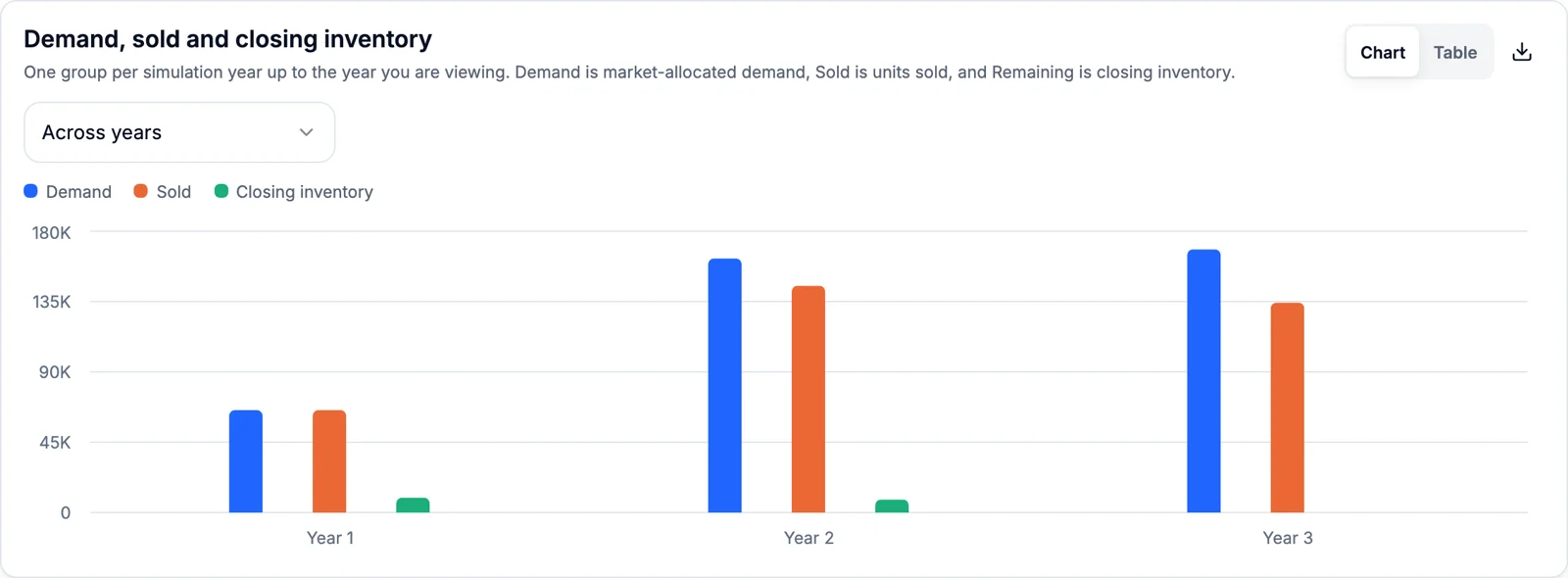
A 52-week schedule of purchasing, sales and stock. If stock runs out, the sales are lost.
See the field
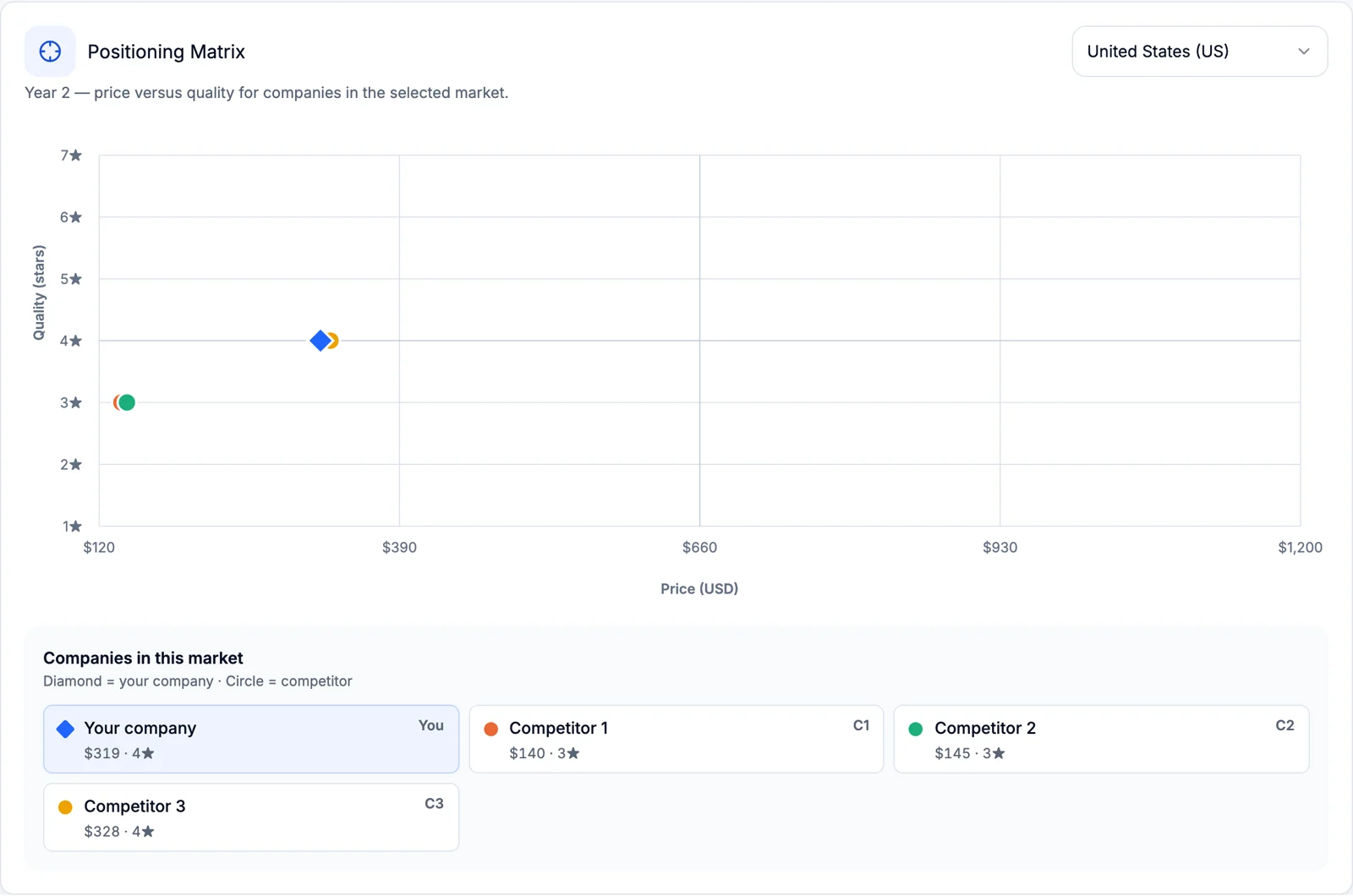
A positioning matrix plots every company's price against its quality in each country.
Market demand, one Year
- Your company
- Rival A
- Rival B
- Rival C
Share is won on three things, against whatever rivals do:
- Price
- Quality
- Marketing
Sales are also capped by the stock actually on hand that week.
Accounting
Every learner keeps their own books
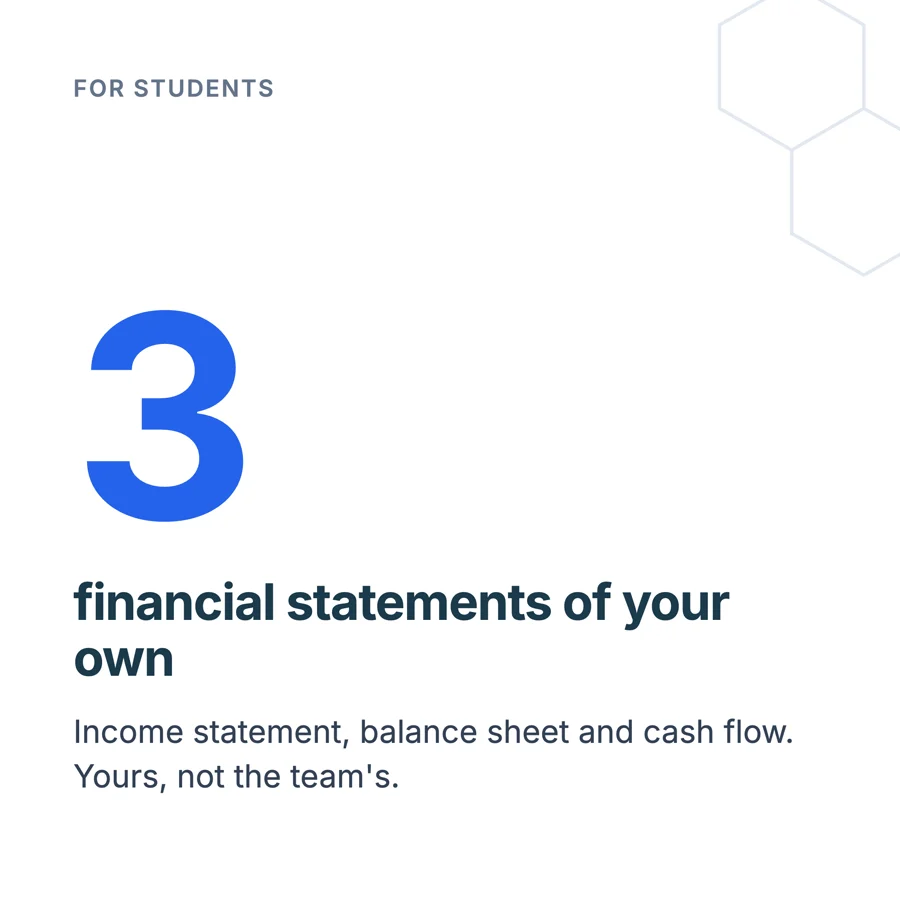
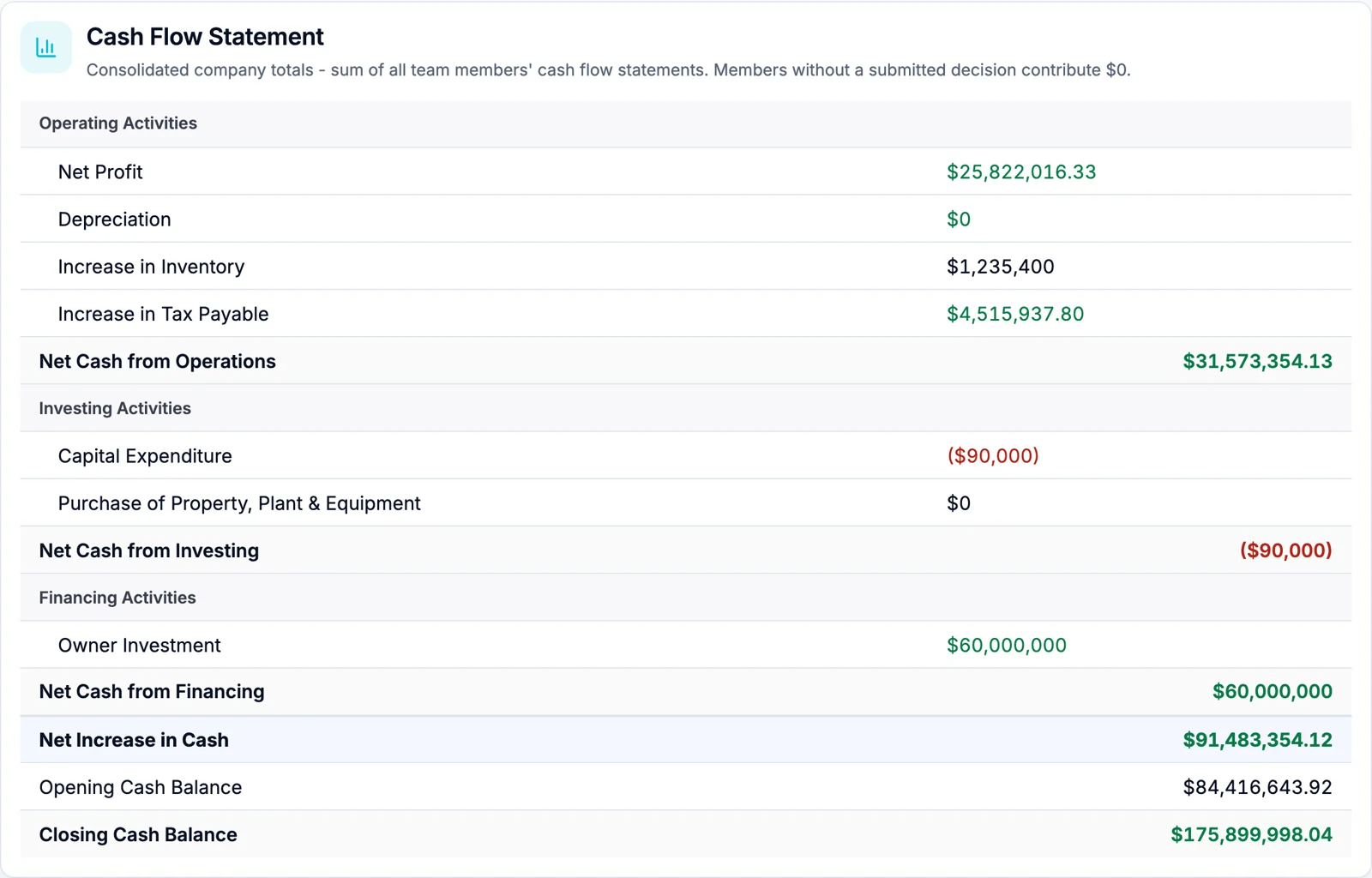
EdXsim runs a complete double-entry ledger for each learner, with FIFO inventory costing, and derives an income statement, balance sheet and cash-flow statement from it. A company's statements are the sum of its members' statements, so each member's contribution is visible.
If a number can't be trusted, EdXsim says so.
Statements come from the ledger, and six self-consistency checks test every set of them. A result that fails a check is flagged rather than quietly balanced, and the instructor can recalculate that single company without disturbing the rest of the cohort.
Assessment
Scored against the strategy each learner chose
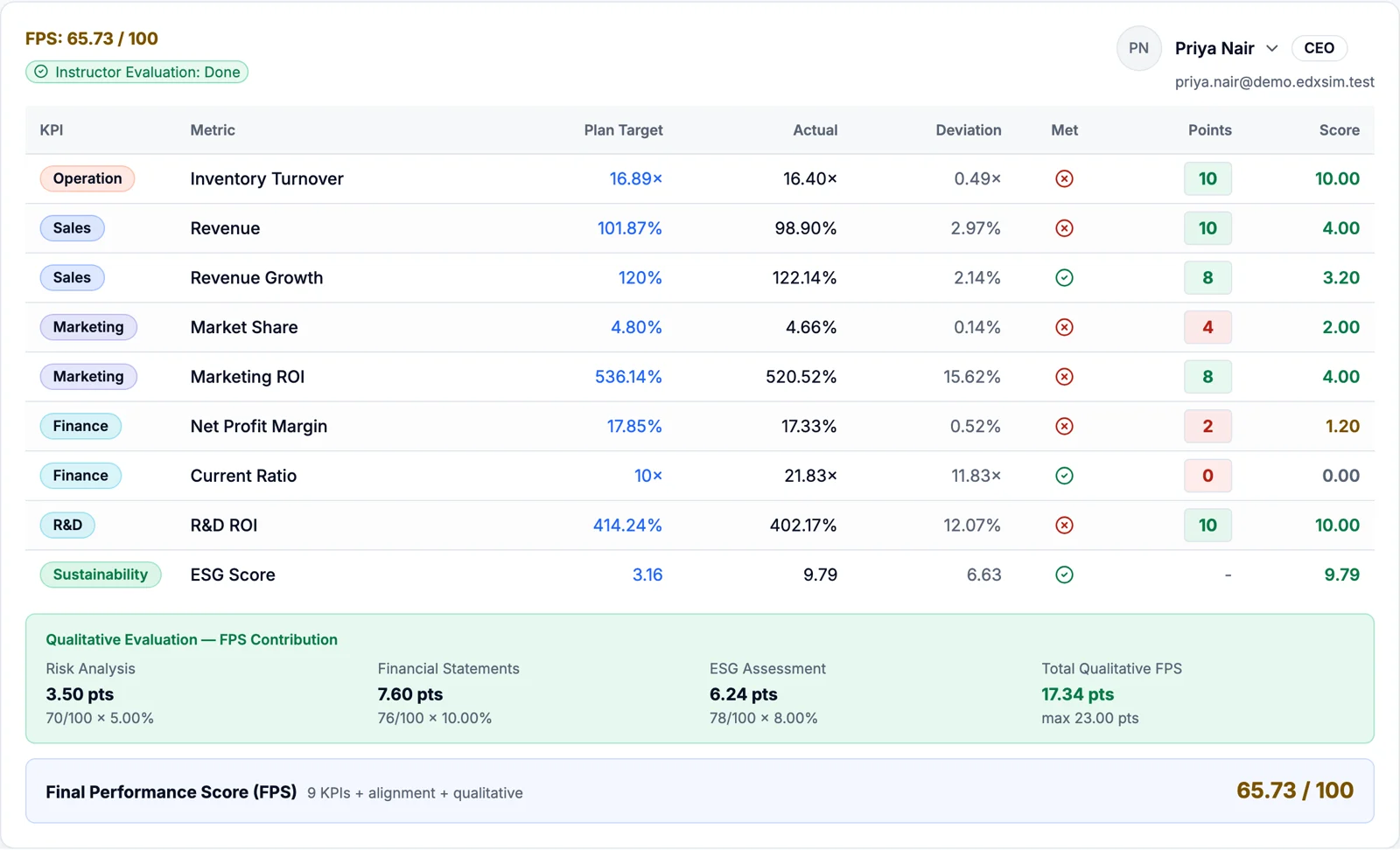
Eight KPIs are scored by how far each result lands from the learner’s own target. How many points are available depends on whether the target was ambitious and whether it fits the company’s competitive strategy. Accurate forecasting and disciplined execution score well, and so does being bold when it fits the strategy.
The Final Performance Score
0–100, fifteen weighted components in four groups.
Quantitative KPIs
- Inventory turnover
- Revenue
- Revenue growth
- Market share
- Marketing ROI
- Net profit margin
- Current ratio
- R&D ROI
Sustainability
- ESG delivery (calculated)
- ESG assessment (instructor)
Strategy alignment
- Vision
- Growth path
- Management focus
Instructor judgement
- Risk analysis
- Financial statements
Final Performance Score
15 weighted components, four groups
- Quantitative KPIs
- 8
- Sustainability
- 2
- Strategy alignment
- 3
- Instructor judgement
- 2
- 12
- scored by the platform
- 3
- graded by the instructor
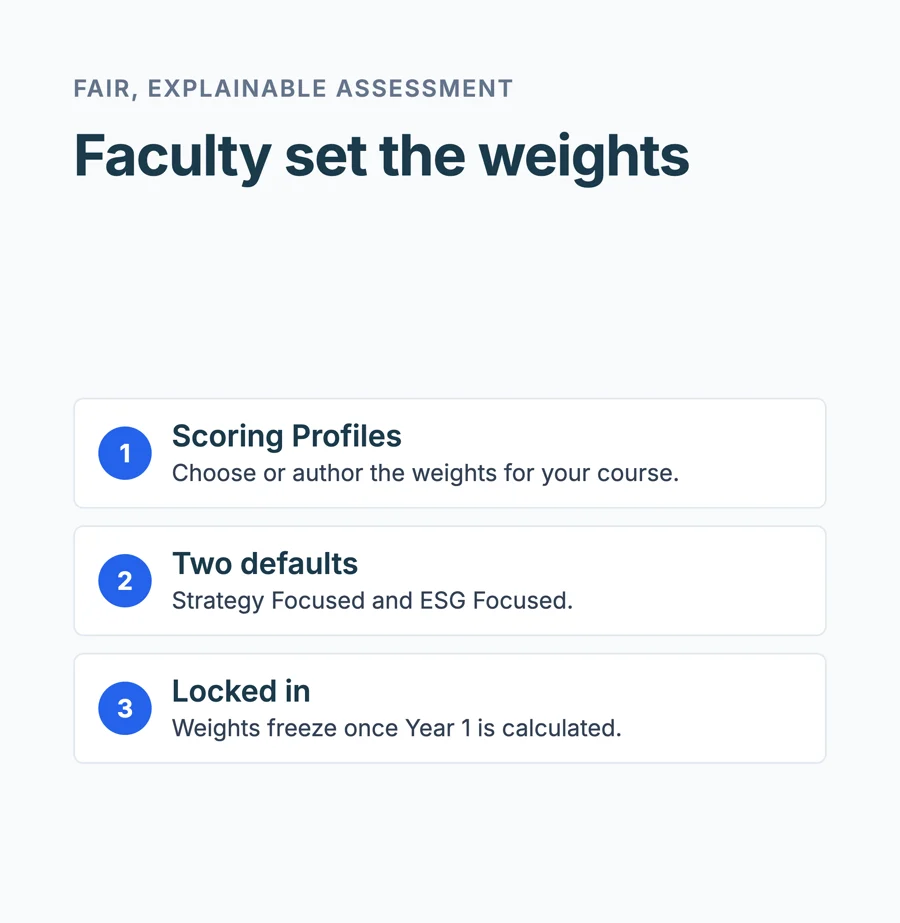
Instructors set how much each component counts, through Scoring Profiles.
Scoring profiles
Instructors and institution admins decide how much each component counts. Start from a ready-made profile (Strategy Focused or ESG Focused), duplicate it and adjust the weights, or build your own. Profiles are shared across the institution. Weights lock when Year 1 is calculated, so every Year of a program is scored the same way.
Company scores
The average of all members (All-members mode) or the CEO's score (CEO-only mode). A member who doesn't submit scores zero for that Year. Companies are ranked by score, then revenue.
Scoring, sustainability and certificates, in 30 seconds each
How the score is built
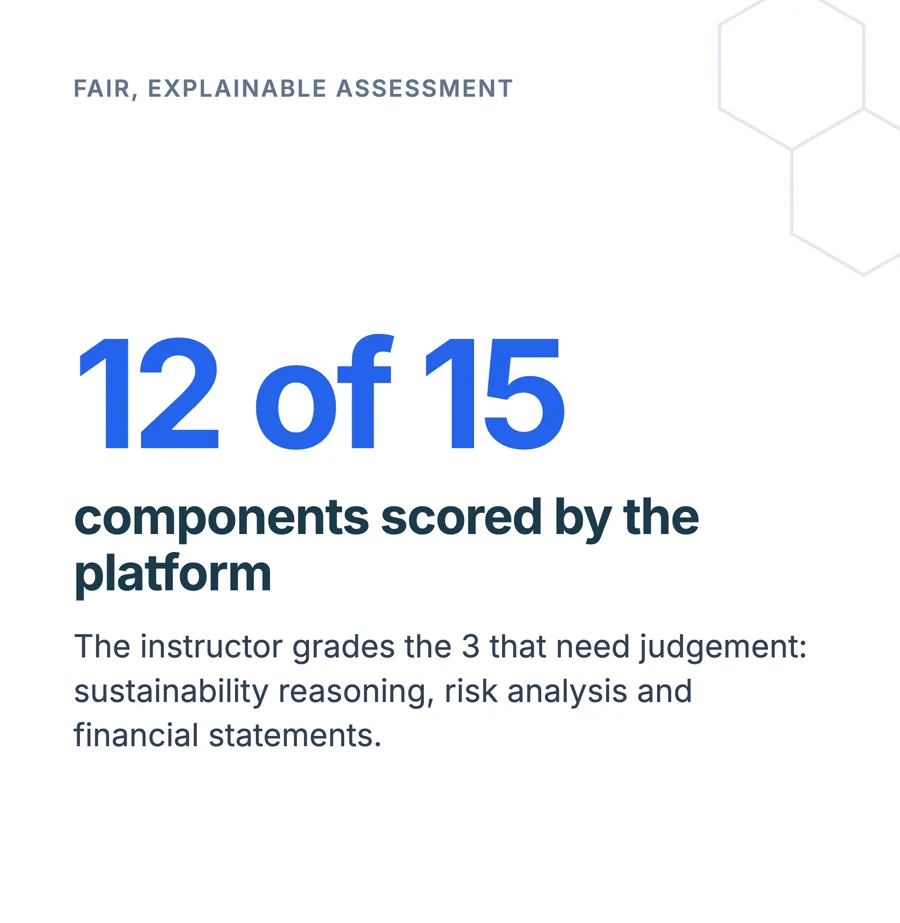
The Final Performance Score: 15 weighted components, 12 scored by the platform and 3 graded by the instructor.
34 seconds · silent · text on screen
Read the text of this videoHide the text of this video
- AssessmentHow the score is builtThe Final Performance Score, from 0 to 100.
- The score has15 weighted componentsWeights come from the Scoring Profile the instructor chooses.
- Four groups1. 8 quantitative KPIsRevenue, market share, margin and more.2. 1 sustainability scoreWhat decisions actually delivered.3. 3 alignment checksFit with the chosen strategy.4. 3 qualitative marksGraded by the instructor.
- Of those 1512 are scored by the platformThe instructor grades the 3 that need judgement.
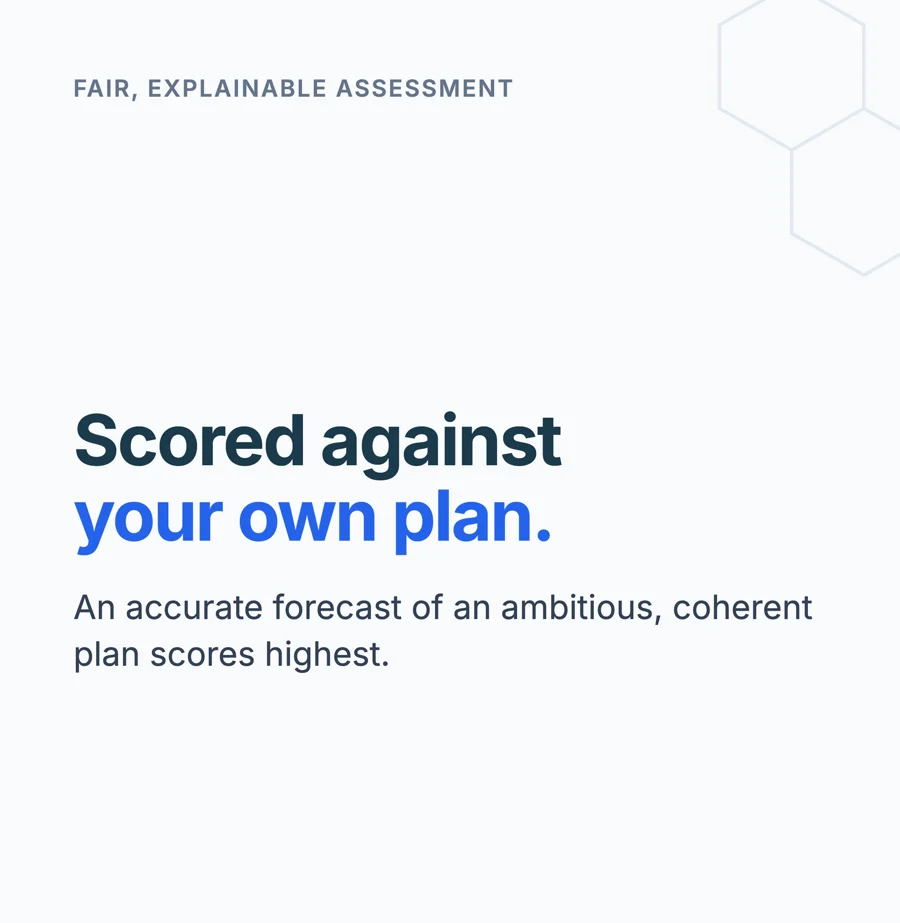
- The principleScored against your own targets.An accurate forecast of an ambitious plan scores highest.
- Assessment you can defend.Request a demoedxsim.com
Sustainability, scored
How sustainability is assessed: scored by the platform against the plan, and graded by the instructor.
34 seconds · silent · text on screen
Read the text of this videoHide the text of this video
- ESGSustainability, scoredHow EdXsim assesses ESG, not only teaches it.
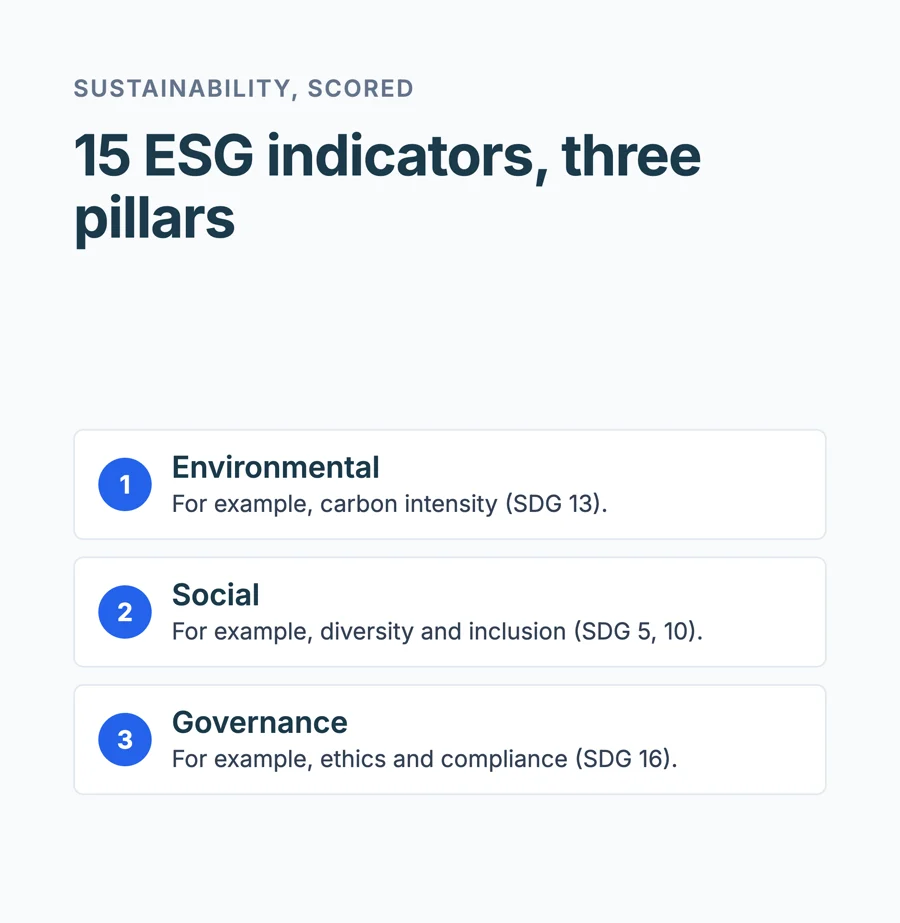
- Every learner works with15 ESG indicatorsFive environmental, five social, five governance.
- Mapped to UN SDGs1. Carbon intensitySDG 13.2. Diversity and inclusionSDG 5 and SDG 10.3. Ethics and complianceSDG 16.
- Scored in two layers1. The platformScores what decisions deliver against the plan.2. The instructorGrades the sustainability reasoning.
- Promised in the plan. Proven in the decisions.
- Sustainability that is scored, not only taught.Request a demoedxsim.com
Seven kinds of certificate
Seven kinds of certificate, each with a credential ID and a QR code for public verification.
29 seconds · silent · text on screen
Read the text of this videoHide the text of this video
- Evidence and credentialsSeven kinds of certificateAnd every one can be verified.
- Three groups1. ParticipationFor completing the program.2. Overall excellence1st to 5th place.3. Category awardsFive areas of performance.
- The five categoriesRevenue. Profit. Market share. Marketing. Sustainability.
- On every certificate1. Up to three signatoriesIncluding one from EdXsim.2. A credential IDUnique to the certificate.3. A QR codeFor public verification.
- Scan it. Verify it.Request a demoedxsim.com
Sustainability
ESG that is planned, delivered and assessed
Learners choose from 15 ESG initiatives: five environmental, five social and five governance, each mapped to UN Sustainable Development Goals. The platform scores how much of that commitment their supplier choices actually cover, and instructors separately assess each learner’s sustainability reasoning. With the ready-made profiles, sustainability carries 20% (Strategy Focused) or 60% (ESG Focused) of the score. A custom profile can weight it higher or lower.
ESG initiatives
Mapped to the UN Sustainable Development Goals, and scored in both the plan and the decisions.
- Strategy Focused
- 20%
- ESG Focused
- 60%
Share of the score in each ready-made profile. A custom profile can weight it higher or lower.
Results
Feedback that explains itself
For learners
- A dashboard: overview, risk analysis, performance trends, business scorecard, financial indicators and leaderboards
- Their own and their company’s income statement, balance sheet and cash-flow statement
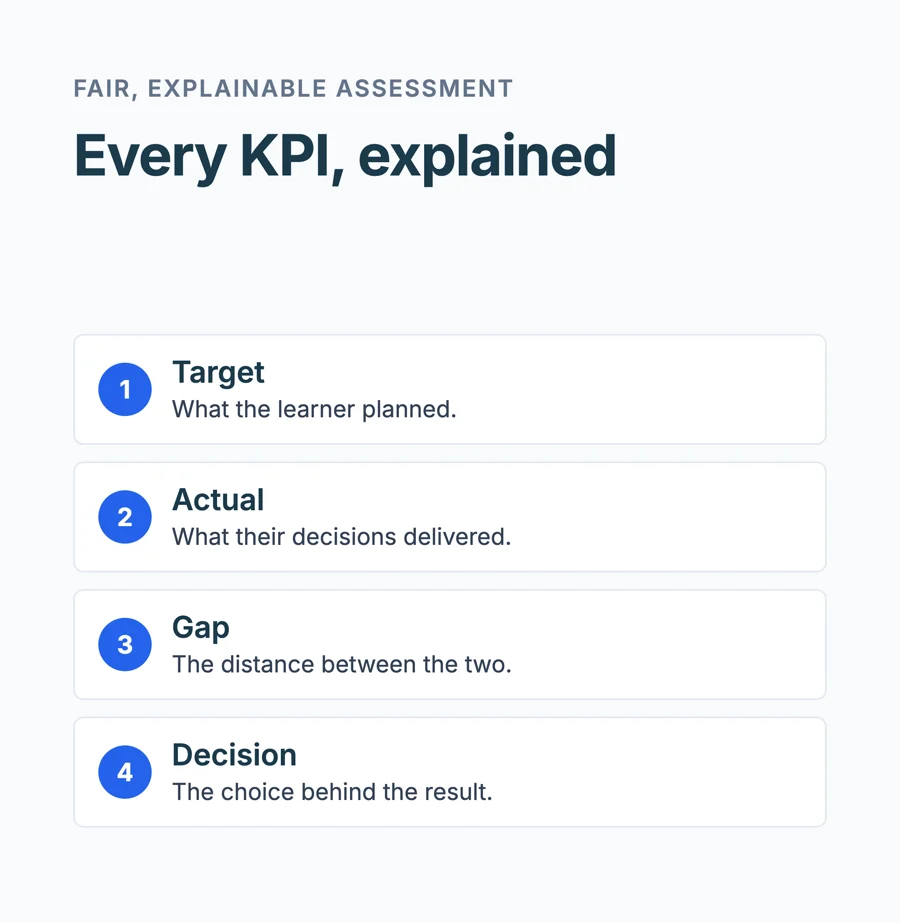
- A KPI analyzer: target against actual against points, KPI by KPI
- The 52-week inventory schedule, market breakdown and positioning matrix
For instructors
- Company rankings and a drill-down into any company’s analyzer
- Submission tracking and financial indicators
- A market-entry matrix and sustainability rankings
- Stockout and R&D reports
Reports
Reports and certificates
Every program ends with something learners can keep and institutions can show. Reports are drafted by the platform and reviewed by the instructor before they are published.
A report for each Year
A company performance report after every Year, published to the company once the instructor has reviewed it.
A final program report
First Year against final Year for each company, with driver analysis, a proposed SWOT and priorities for the next Year.
Seven kinds of certificate
Participation, overall excellence, and five category awards: revenue, profitability, market share, marketing effectiveness and sustainability.
Public verification
Each certificate carries a credential ID and a QR code. Anyone can check it on a public page.
Instructors
Full control of the program
Set up
Choose the product, the number of Years and the scoring profile; invite learners one by one, in bulk or by CSV (up to 500 at a time); form companies and appoint CEOs.
Run
Schedule Year windows, or start, stop and restart Years yourself. Deadlines are enforced automatically. Approve or reject loan requests, publish program guides and essential readings, and send announcements to everyone or to specific learners.
Grade
Three qualitative assessments (risk analysis per learner, financial statements per company, sustainability per learner). Submitting them updates the Final Performance Score and rankings.
Class size
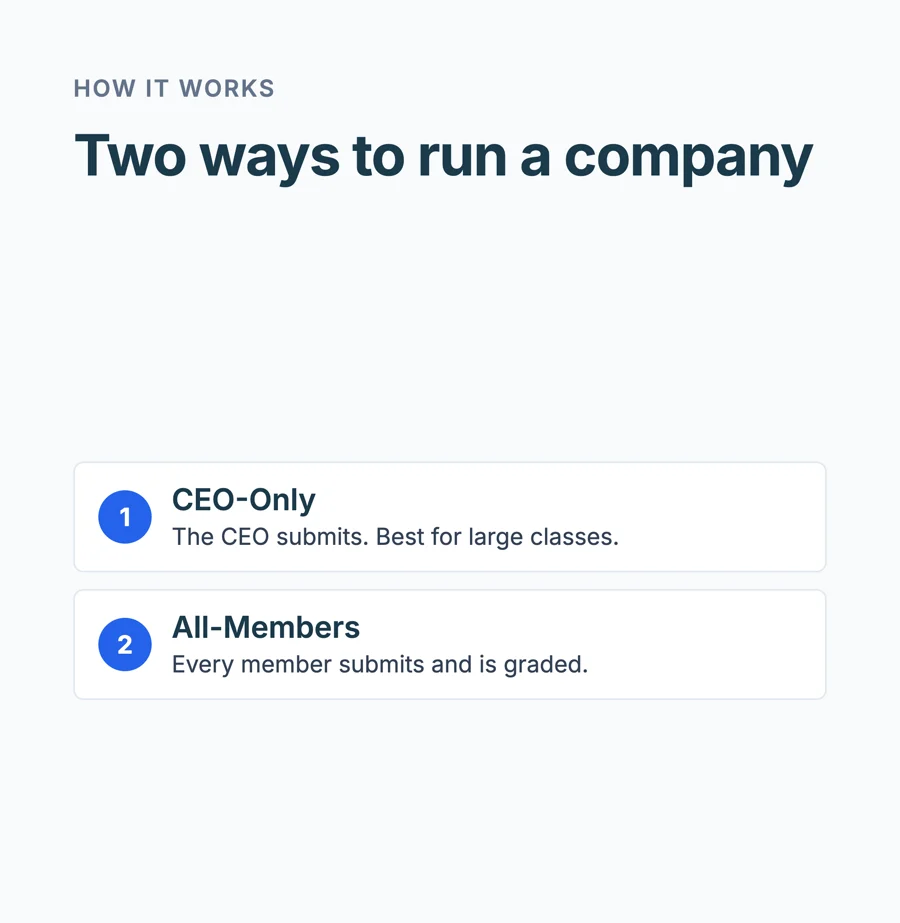
Use CEO-only mode for large classes, where each company’s CEO makes the decisions, or All-members mode so every learner plays and is scored.
Institutions
Run every program from one account
- Create, schedule and activate programs, and assign instructors
- Invite administrators, instructors and learners; deactivate and reactivate access for one program or for the whole institution
- A shared scoring-profile library, showing which programs use each profile
- Program dashboards across the portfolio
- Program branding: a theme colour and up to five partner or sponsor logos per program
Security
Built for institutional data
Invitation-only access
There is no public sign-up, and every account is created from an invitation issued by someone authorised to invite that role.
Role-based permissions
Platform, institution, instructor and learner roles, and each account holds one role type.
Data separated by institution
Every record belongs to one institution, and access is filtered by institution.
Encrypted connections
TLS throughout, and sessions that expire.
Hosted in the UK
Amazon Web Services, London region, with managed databases and automated backups.
At a glance
Simulation at a glance
- Program length
- 1–10 Years, set by the instructor
- Scale
- Up to 100 companies per program, up to 8 learners per company
- Company roles
- CEO, COO, CSO, CMO, CFO, CPO, CLO, CCO
- Gameplay modes
- CEO-only · All-members
- Products
- Bicycle · Smartphone · Drone
- Markets
- United States · United Kingdom · Bangladesh · Nigeria
- Suppliers
- 8 manufacturers · 8 distributors
- Financial statements
- Income statement · Balance sheet · Cash-flow statement, per learner and per company
- Score
- Final Performance Score, 0–100, 15 components, 12 scored by the platform
- Sustainability
- 15 ESG initiatives mapped to the UN SDGs
- Reports
- One for each Year, and one for the whole program
- Certificates
- 7 kinds, verifiable by credential ID or QR code
- Onboarding
- Invitation only. Bulk CSV up to 500 learners
- Hosting
- AWS London (UK)
Requirements
Requirements
- A current version of Chrome, Edge, Firefox or Safari on a desktop or laptop.
- Nothing to install. There is no mobile app, and EdXsim needs an internet connection.
- The interface is in English.
Coming soon
Coming soon
These are in development. They are not part of EdXsim today, and everything above this line is.
- Coming soon
EdXsim Coach
AI coaching for learners between Years
- Coming soon
EdXsim Forecast
Forecasts of revenue, market share and risk
- Coming soon
AI-assisted grading
Suggested qualitative marks for instructors to confirm
- Coming soon
AI competitor companies
Simulated rivals so a cohort can run with fewer companies
- Coming soon
LMS integration
Launch from your LMS and send grades back
- Coming soon
Single sign-on and MFA
Sign in with your institution's identity provider
Coming soon features are in development and are not available today. We don't publish release dates, and plans can change.
See EdXsim with your course in mind
Tell us what you teach and how large your cohorts are. We'll walk you through a program set up for it.
No credit card needed